
Article · 5 min read
Error Baseball Cards Worth Money (and How to Spot Them)
· By the Sports Card Value Scanner team
Quick answer
Error baseball cards are worth money when the mistake was caught and corrected during printing, which makes the error version scarce, or when the card is famous or shows a star player. The best-known examples are the 1990 Topps Frank Thomas “No Name on Front”, the 1989 Fleer Billy Ripken bat-knob card and the 1969 Topps Mickey Mantle “white letter” variation. Most other errors, like a wrong stat printed on every copy, add little or no value.
An error card is a card printed with a mistake: a missing name, a reversed photo, the wrong player, wrong stats, or something in the picture that shouldn't be there. Collectors only pay extra for errors in a few situations. The most valuable errors were noticed and corrected while the set was still being printed, which leaves fewer error copies than corrected ones; the Frank Thomas “No Name on Front” is the classic example. Errors that became famous, like the 1989 Fleer Billy Ripken, can carry a premium even though many copies exist. Errors on cards of star players also benefit from that player's demand. An error that was never corrected usually isn't scarce, so it sells like the regular card. Before you price an error, confirm exactly which version you have, because the scarce version and the common one can look almost identical at a glance.
| Worth more when | Corrected mid-print, famous, featuring a star, in great condition |
|---|---|
| Usually not worth more | Errors never corrected, which appear on every copy |
| Famous examples | 1990 Topps Frank Thomas NNOF, 1989 Fleer Billy Ripken, 1969 Topps Mantle white letter |
| Watch for | Fake errors made by scraping or covering the print on a normal card |
When is an error card worth more?
An error card is worth more when it was corrected mid-print, when it's famous, when it shows a star player and when it's in great condition.
- It was corrected mid-print. Fewer error copies exist than corrected copies.
- It's famous. Media attention or a good story keeps demand high.
- It features a star. A Hall of Famer's error sells to that player's collectors as well as to error collectors.
- It's in great condition. As with any card, condition multiplies the value.
Errors that were never corrected, such as a misspelled name that appears on every copy, usually don't add value, because the error is simply the only version of the card.
What are the most famous baseball error cards?
The best-known entries on any baseball error cards list are the 1990 Topps Frank Thomas No Name on Front, the 1989 Fleer Billy Ripken and the 1969 Topps Mickey Mantle white letter variation.
| Card | The error | Why it matters |
|---|---|---|
| 1990 Topps Frank Thomas #414 | Some copies printed with no name on the front | A scarce error on a Hall of Famer's rookie card |
| 1989 Fleer Billy Ripken #616 | An obscenity written on the bat knob | Fleer covered it with a black box, Wite-Out and scribbles, creating several collected versions |
| 1969 Topps Mickey Mantle #500 | Last name printed in white instead of yellow | A scarce variation of Mantle's last regular Topps card |
| 1957 Topps Hank Aaron #20 | Reversed photo shows Aaron batting left-handed | Famous, but never corrected, so the value comes from Aaron |
| 1987 Donruss Opening Day Barry Bonds #163 | The photo shows Johnny Ray, not Bonds | A well-known error on a Bonds rookie-year card |
| T206 Sherry Magee | Name misspelled “Magie” | Corrected quickly, so the error is a scarce pre-war card |
| 2006 Topps Alex Gordon #297 | Printed before Gordon's debut, against rookie card rules | Pulled from production, so few copies exist |
Are there error cards worth money in other sports?
Yes. Error cards worth money turn up in football, basketball and hockey too, and the same rules apply: scarcity from a mid-print correction, a famous player or a famous story. Modern sets also produce misprints, miscuts and printing plates, which are collected one card at a time. Price any one-off misprint carefully, because its value depends entirely on what collectors will pay for that specific card.
How can you tell if you have the error version?
Confirm the exact card, compare it with photos of the corrected version, check for alterations and price it only against sales of the same error.
- 1
Know the exact card
Confirm the year, set and card number on the back. Errors are usually tied to one specific card number. Our guide on how to identify sports cards shows where to look.
- 2
Compare it with the corrected version
Look at clear photos of both versions side by side, and check the name, team, position and photo.
- 3
Check for alterations
Some fake errors are made by scraping or covering the print on a normal card. Look at the surface under a light and a loupe, and see how to tell if a sports card is fake.
- 4
Price the right version
Search sold listings with the error's name in the query, and make sure the sales match your version and condition.
What's the difference between errors, variations and misprints?
An error is a mistake in the design or information, a variation is a difference between copies of the same card number, and a misprint is a one-off printing problem.
- Error: a mistake in the design or information, like a wrong photo or a missing name.
- Variation: a difference between copies of the same card number, like a different photo or colour. Modern sets include deliberate short-printed photo variations.
- Misprint: a one-off printing problem, like an ink smear, a miscut or a missing colour layer. Value varies card by card.
Many collectible errors come from the late 1980s and early 1990s. Our guide to valuable baseball cards from the 80s and 90s covers the rest of that era.
Can a scanner app find error cards?
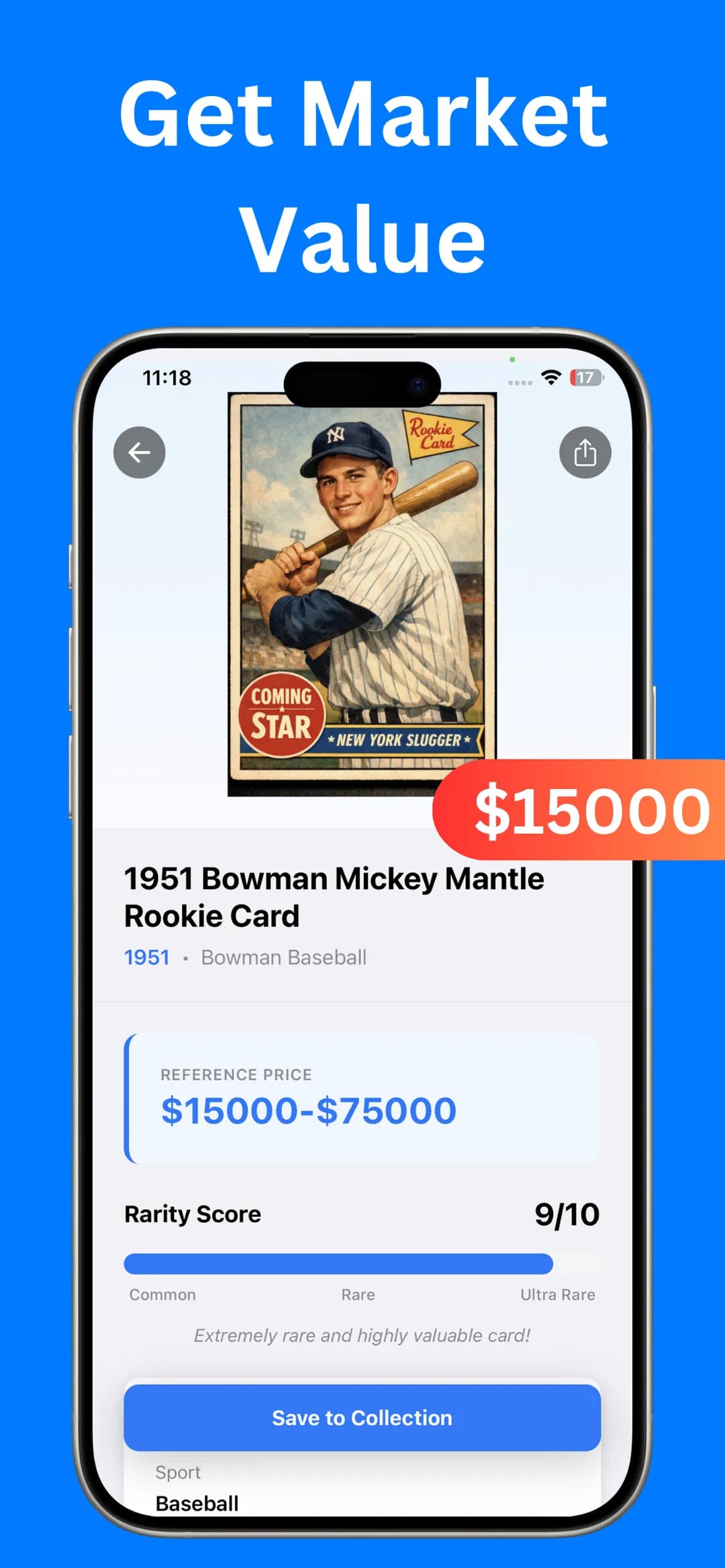
Not directly. Sports Card Value Scanner helps with the first step: scan the card to confirm its year, set and card number, with a reference price range and rarity score. The app identifies the card itself, not the error version, so check the name, photo and details by eye against the known error before you price it.
Frequently asked questions
Are error cards worth more money?
Only some. Errors that were corrected during printing are scarce and often worth more. Errors that appear on every copy usually sell like the normal card.
What is the most valuable baseball error card?
Among modern cards, the 1990 Topps Frank Thomas “No Name on Front” is the best-known valuable error, and top-graded copies sell for far more than the regular rookie card. Our 1990 Topps guide shows how to spot it. Among vintage cards, the 1969 Topps Mickey Mantle white letter variation is a major one.
How do I sell an error card?
Get it graded if it's valuable, because grading confirms it's genuine and unaltered. Then list it with the error's name in the title so error collectors can find it.
Sources

Find out what your cards are worth
Scan your first card in seconds. Get the card details, a reference price range and a rarity score, then build a collection you can track.


4.5★ App Store (75) · 4.4★ Google Play (79) · Free to download