
Step-by-step guide · 5 min read
How to Tell If a Sports Card Is Fake
· By the Sports Card Value Scanner team
Quick answer
To tell if a sports card is fake, compare it side by side with a genuine copy of the same card. Look at the print under a loupe, where genuine cards show a fine, regular dot pattern. Check the card stock, thickness and gloss, inspect the edges and the back, and look for wrong fonts or colours. For a graded card, look up its certification number on the grader's website. If a valuable card is priced far too low, assume it's fake until proven otherwise.
Counterfeit sports cards are concentrated among valuable cards: vintage stars, famous rookie cards, autographs and high-grade slabs. Most fakes are caught by comparing the card with a known genuine copy, because counterfeiters rarely get everything right at once. The print is the strongest clue. Genuine cards are printed with a fine, regular pattern of dots that you can see under a 10x or stronger loupe, while many fakes show blurry, irregular dots or a pixel grid from a digital printer. Card stock, thickness, gloss, edge cuts, fonts and the colours on the back are the next things to check. Slabs can be faked too, so always verify a graded card's certification number with the grader and make sure the card and details match. When a card is worth real money and you're unsure, pay for professional authentication before you buy.
| Most-faked cards | Pre-war and 1950s stars, iconic rookies, famous errors, autographs and high-grade slabs |
|---|---|
| First check | Compare side by side with a genuine copy |
| Print test | Genuine cards show a fine, regular dot pattern under a loupe |
| Slabs | Look up the certification number on the grader's website |
| Red flag | A valuable card priced far below market |
Which sports cards get faked?
Counterfeiters target valuable cards, not commons. Fakes cluster around cards worth enough to pay off the effort: pre-war and 1950s stars, iconic rookie cards from every era, famous error cards, autographs and high-grade slabs of all of these. If you're looking at one of those, slow down.
How do you check if a sports card is fake?
Compare the card with a genuine copy, check the print under a loupe, the card stock, edges and back, and verify any slab's certification number. If you're working out how to tell if a baseball card is fake, a football card or a basketball card, the order is the same.
- 1
Compare it with a genuine copy
Put the card next to one you know is real, or next to large, clear photos of a graded copy. Check the image, borders, fonts, logos and colours on both sides. Small differences add up.
- 2
Look at the print under a loupe
Genuine cards show a fine, regular pattern of coloured dots. Fakes often show fuzzy dots, smeared colour or a square pixel grid from a digital printer. A 10x loupe works, and stronger magnification is better.
- 3
Check the card stock
Compare the thickness and stiffness with a genuine card from the same set. Many fakes are too thin or too glossy, or the cardboard edge is the wrong colour.
- 4
Inspect the edges
Factory-cut edges look consistent within a set. Unusually clean, wavy or uneven edges can point to a fake or to a card that's been trimmed.
- 5
Read the back
Counterfeiters often get the back wrong: blurry text, the wrong font weight, misaligned stats or colours that don't match the set.
- 6
Try a blacklight
Under UV light, some modern paper and inks glow where older cardboard doesn't. It's a useful extra clue on vintage cards, not proof on its own.
- 7
Verify the slab
Look up the certification number on the grading company's website, and check that the card, grade and any image match. A cert number that doesn't exist, or that belongs to a different card, means trouble.
- 8
Check the price and the seller
A rare card far below market price, a seller with no history, or a seller who won't show the back or close-up photos are all warning signs.
How can you tell if a vintage baseball card is fake?
To learn how to tell if a vintage baseball card is fake, start with the print and the card stock, because vintage cards were printed differently from modern ones. Under magnification, older cards show a coarser dot pattern, and the cardboard should look and feel its age, often grey or cream on the edges.
Reprints are the common trap. Many legitimate reprints of famous vintage cards exist, and they're often marked with the word “reprint” or a modern copyright line on the back. Check the size too, because some reprints are slightly larger or smaller than the originals.
How do you spot fake autographs and fake slabs?
Autographs are faked more often than the cards themselves. Certified autographs inserted by the manufacturer carry a stamp or a statement on the back. Signed cards without one need authentication from a recognised autograph authenticator to be worth much. With slabs, watch for labels with the wrong font or layout, a case that's been opened and resealed, and cert numbers that don't match the card.
When should you pay for authentication?
If a card is worth more than you're comfortable losing, get it graded or authenticated before you pay, or buy it already graded by a reputable company. Graders check authenticity as part of grading, and counterfeit or altered cards don't get a numeric grade. Our guide on how to get cards graded walks through the process, and error cards worth money covers a category that's often faked.
Can a scanner app tell if a card is fake?
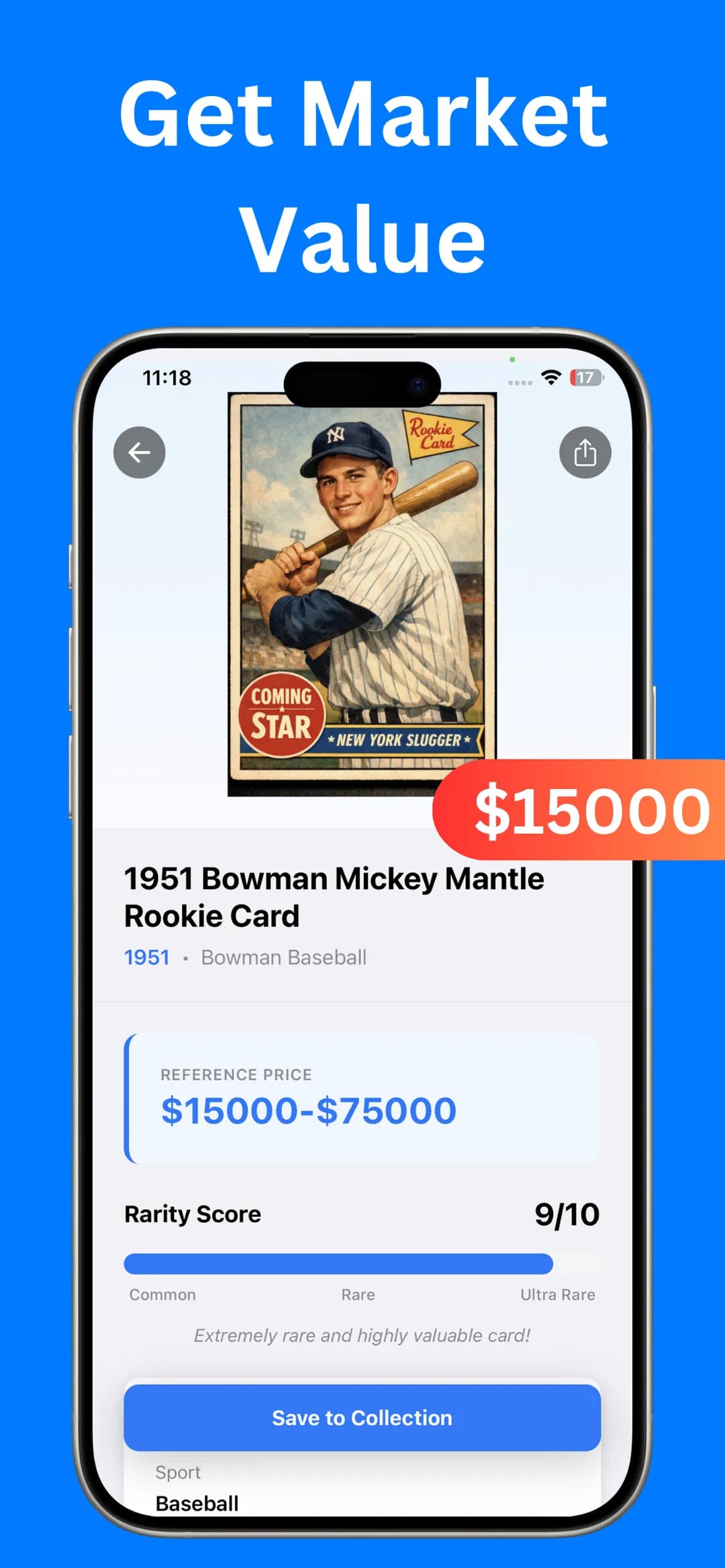
No. Sports Card Value Scanner can't authenticate a card. What it can do is tell you what the genuine card should be. Scan the front to see the card's year, set and card number, plus a reference price range and rarity score. That's useful when a seller's price looks too low, or when you want to confirm the set and number before comparing with a genuine copy. Our guide on how to identify sports cards explains where those details live.
Frequently asked questions
Are there fake sports cards?
Yes. Counterfeits exist for valuable vintage cards, famous rookie cards, autographs and graded slabs. Commons are rarely faked because they aren't worth the effort.
Can a grading company tell if a card is fake?
Yes. The major graders check authenticity as part of grading, and counterfeit or altered cards don't receive a numeric grade.
What tools do I need to spot a fake card?
A loupe of at least 10x, a bright light, a genuine copy or clear photos of one to compare, and optionally a UV blacklight. For slabs, use the grader's online certification lookup.
Sources

Find out what your cards are worth
Scan your first card in seconds. Get the card details, a reference price range and a rarity score, then build a collection you can track.


4.5★ App Store (75) · 4.4★ Google Play (79) · Free to download