
Article · 5 min read
Are My Old Sports Cards Worth Anything?
· By the Sports Card Value Scanner team
Quick answer
Maybe. Sports cards from before about 1980, especially stars and rookies, are often worth something even in worn condition. Cards from the junk wax era (roughly 1987 to 1994) were printed in huge numbers, so most are worth little unless they're key rookies in top condition, inserts or errors. The quickest way to sort the valuable cards from the rest is to scan them. Sports Card Value Scanner identifies cards from all eras and shows a reference price range and rarity score for each one.
Whether old sports cards are worth anything depends mostly on when they were made. Cards from before about 1980 were printed in smaller numbers and many were thrown away, so stars, rookies and scarce series from those decades often have real value even in worn condition. Cards from roughly 1987 to 1994, the junk wax era, were printed in enormous quantities and saved in mint condition by millions of collectors, so most of them sell for cents. There are exceptions in every era: key rookie cards in top condition, error cards, early inserts and low-numbered modern parallels. The practical approach is to sort by era, pull out recognisable stars and rookies, scan the cards to get a value range and rarity score, and check recent sold prices for the few that stand out.
| Most valuable eras | Pre-war (before 1945) and early post-war vintage (1948 to 1969) |
|---|---|
| Least valuable era | The junk wax era, 1987 to 1994 |
| Biggest value factor | Condition: corners, edges, surface and centering |
| Exceptions to look for | Key Hall of Fame rookies, corrected errors and early inserts |
| Never | Clean, trim or flatten a card |
Which eras of old sports cards are worth the most?
Pre-war and early post-war vintage cards are worth the most, cards from the 1970s and early 1980s are mixed, and most junk wax era cards from 1987 to 1994 are worth little.
| Era | Roughly | What to expect |
|---|---|---|
| Pre-war | Before 1945 | Scarce. Tobacco and candy cards can be valuable even in poor condition |
| Early post-war vintage | 1948–1969 | Stars, rookies and scarce high-number series are in demand; condition matters a lot |
| Late vintage | 1970s | More plentiful; stars, rookies and well-centred cards still sell |
| Early modern | 1980–1986 | Mixed; key rookies can be valuable, many base cards are modest |
| Junk wax era | 1987–1994 | Massive print runs; most base cards are worth little |
| Modern | 1995–today | Inserts, parallels, autographs and numbered cards drive value |
Are my old baseball cards worth anything?
Old baseball cards are often worth something if they're vintage, because baseball has the deepest vintage market. Check any 1950s or 1960s Topps or Bowman cards, stars, Hall of Famers or rookies carefully. Even creased copies of key players can sell. Commons from the 1970s may only be worth a little each, but stars and complete sets add up.
Cards from the late 1980s and early 1990s are a different story, as the next section explains. For the full baseball breakdown, read how much is my baseball card worth.
What are junk wax era cards worth?
The junk wax era refers to the late 1980s and early 1990s, when card companies printed far more cards than collectors could ever absorb. So many copies survive in mint condition that most junk wax era cards are worth very little, often just cents each.
There are still exceptions worth looking for:
- Key rookie cards of Hall of Famers in near-perfect condition, especially when professionally graded.
- Error cards and variations that were corrected during the print run.
- Early inserts and limited subsets from the early 1990s.
Scanning a box of junk wax era cards is a fast way to find these exceptions without researching every card by hand.
How do you check if your old cards are worth anything?
Sort them by era, scan or look up each card, set aside the high scorers and check recent sold prices for the best ones.
- 1
Sort by era and sport
Pull out anything from before 1980 and any recognisable stars or rookies first. Those are the cards most likely to have value.
- 2
Scan the cards
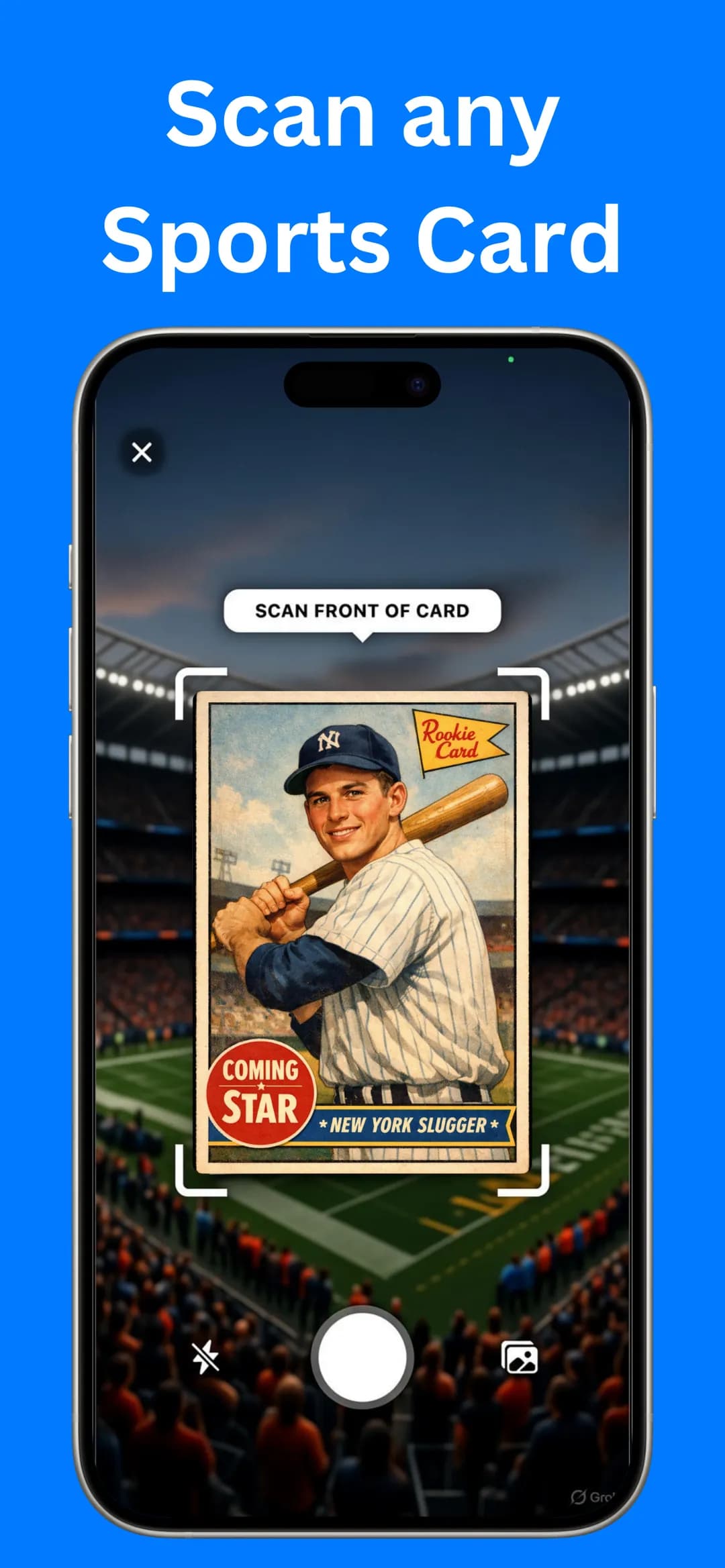
Open Sports Card Value Scanner and scan the front of each card, or choose photos from your gallery. Each result shows the card's year and set, a reference price range and a rarity score.
- 3
Set aside the high scorers
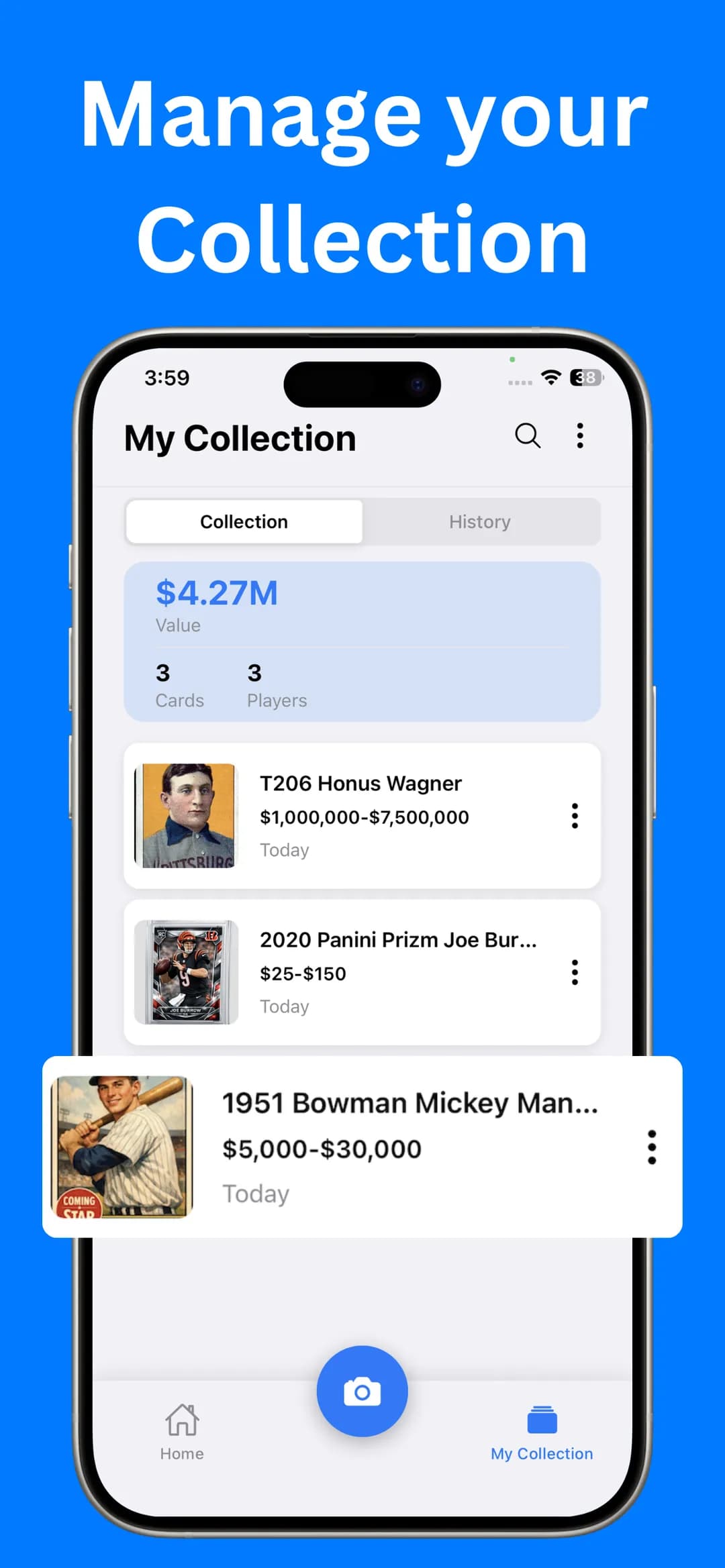
Save promising cards to My Collection and protect them in sleeves and top-loaders. My Collection shows the total value of everything you've saved.
- 4
Verify the best cards
Check recent sold prices for your top cards, and consider grading the valuable ones that are in excellent condition. See how to price sports cards on eBay.
How much does condition matter for old cards?
Old cards rarely survive in perfect shape, so condition separates a modest card from a valuable one. Check the four corners, the edges, the surface (creases, stains, print marks) and the centering. Don't try to clean, trim or flatten a card. Alterations destroy value, and grading companies reject altered cards.
Keep cards away from rubber bands, sunlight and damp basements, and store valuable ones in rigid holders. For a quick checklist of what makes a card worth money, read how to tell if a sports card is valuable.
What can you do with old cards that aren't valuable?
Keep complete sets together, sell commons in bulk lots, pass them on to new collectors or keep the ones that mean something to you.
- Keep sets together. A complete set may be worth more than its individual commons.
- Sell commons in bulk lots. Some collectors buy lots to complete sets or for nostalgia.
- Pass them on. Old cards make a great starter collection for kids or new collectors.
- Keep the sentimental ones. Not every card needs a price tag.
Whatever you keep, a sports card collection app makes it easy to remember what you have and what it's worth.
Frequently asked questions
What years of sports cards are worth the most?
Older cards are generally scarcer. Pre-war and 1950s–1960s cards carry the most value per card, especially stars and rookies. Modern cards can also be valuable when they're serial-numbered, autographed or key rookies. Cards from roughly 1987 to 1994 are the least valuable on average.
Should I get my old cards appraised?
For most collections, start by scanning to sort the cards, then check sold prices for the best ones. Consider a professional appraisal or grading for high-value cards, or for insurance and estate purposes.
Sources

Find out what your cards are worth
Scan your first card in seconds. Get the card details, a reference price range and a rarity score, then build a collection you can track.


4.5★ App Store (75) · 4.4★ Google Play (79) · Free to download