
Article · 5 min read
How to Tell If a Sports Card Is Valuable
· By the Sports Card Value Scanner team
Quick answer
A sports card is likely to be valuable if it combines a star or Hall of Fame player, rookie status, scarcity (an old card, a short print, a serial-numbered parallel or an autograph) and strong condition. The final test is the market: recent sold prices for the same card. To answer “how rare is my sports card?” quickly, scan it with Sports Card Value Scanner. It gives a rarity score out of 10 and a reference price range.
Valuable sports cards usually tick several boxes at once. The player is a star or Hall of Famer, the card is a true rookie card, and the version is scarce, either because it's old, short-printed, serial-numbered, a parallel or signed. Condition is the multiplier: sharp corners, clean edges, an unmarked surface and good centering can turn a decent card into an expensive one, especially if it's worth grading. On the other side, base cards of common players from the late 1980s and early 1990s, damaged cards and reprints rarely carry much value. None of these clues replaces the market. Once a card looks promising, confirm the exact version and check what the same card has recently sold for. A scanner app's rarity score is a quick way to spot the cards worth that research.
| Strongest signs | A star player, rookie card, serial number or short print, or autograph |
|---|---|
| Era clue | Pre-1980 cards survive in smaller numbers; 1987 to 1994 was mass-produced |
| Condition | Sharp corners, clean edges, an unmarked surface and good centering |
| Rarity check | Print run, serial number and parallel version |
| Never | Clean, press or trim a card |
What are the signs a sports card is valuable?
A star player, rookie status, age before the junk wax era, a serial number or short print, a parallel finish, an autograph or memorabilia, and great condition all point to value.
- The player is a star. Hall of Famers, MVPs and fan favourites drive demand. A beautiful card of a common player rarely sells for much.
- It's a rookie card. Look for an RC logo on modern cards, or check whether it's the player's first card in a major set.
- It's old, but not junk wax old. Pre-1980 cards survive in smaller numbers. Most base cards from about 1987 to 1994 were mass-produced.
- It's numbered or short-printed. A stamped serial number like 07/25, or a known short print, means fewer copies exist.
- It's a parallel. A different border colour, or a refractor or prizm finish, usually means a scarcer version of the base card.
- It has an autograph or memorabilia. Signed cards and patch cards sit at the top of most modern sets.
- It's in great condition. Sharp corners, clean edges, an unmarked surface and good centering make a big difference, especially if the card is worth grading.
One clue on its own rarely makes a card valuable. The cards that sell for real money usually tick several boxes at once, like a star player's rookie card in a scarce parallel and sharp condition.
How can you tell if a baseball card is worth money?
Knowing how to tell if a baseball card is worth money starts with three checks: a star or Hall of Fame player, rookie or 1st Bowman status, and strong condition.
Baseball follows the same rules, with a few extras. Check the back for the year and card number, and look for an RC logo or a “1st Bowman” designation on prospect cards. Compare the card with others from the set: error and variation cards can be worth more than the standard version. Then check recent sold prices. Our article on how much your baseball card is worth goes deeper.
How rare is my sports card?
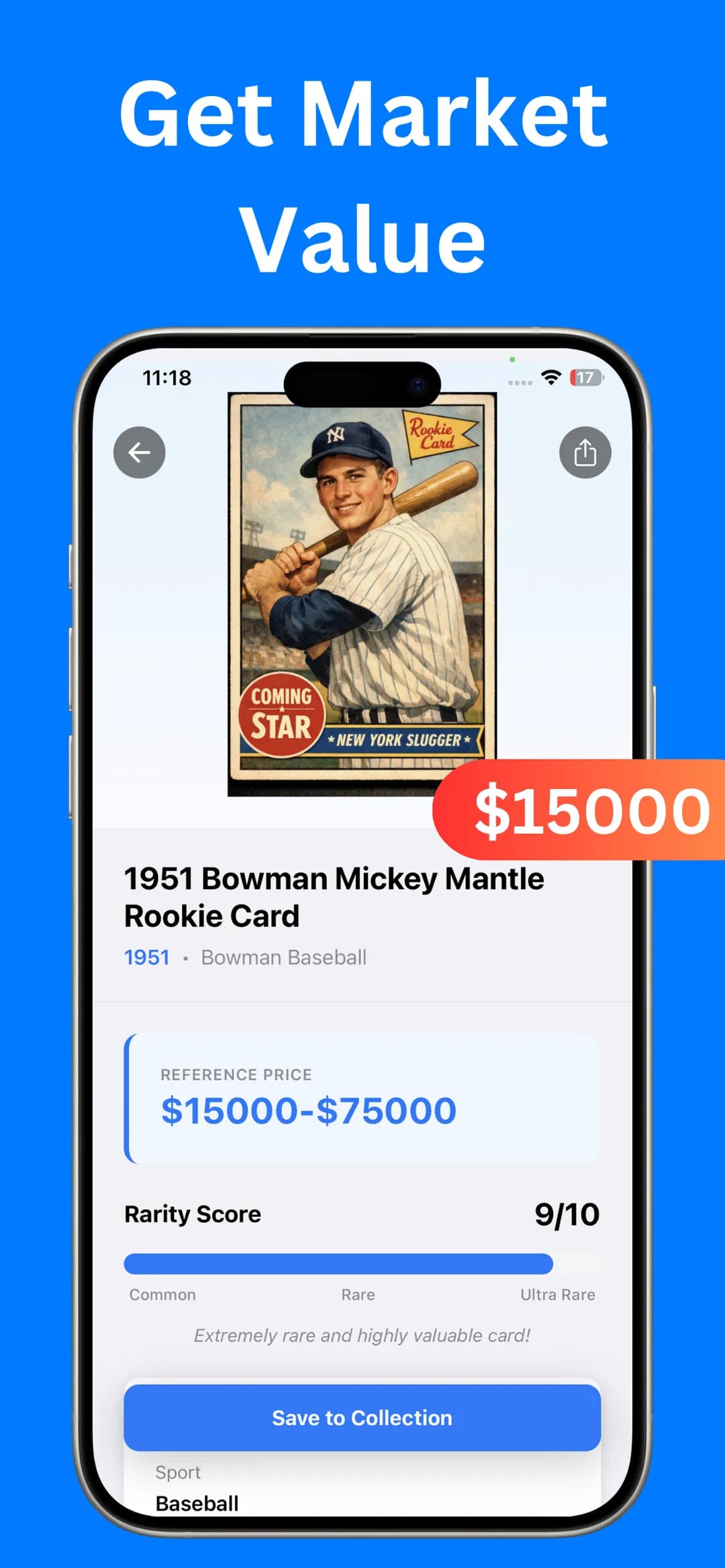
A card's rarity depends on its print run and version, which are hard to judge by eye, especially with modern parallels that look almost identical. Sports Card Value Scanner gives every scan a Rarity Score out of 10, on a scale from Common to Rare to Ultra Rare, with a short verdict such as “Extremely rare and highly valuable card!”
- 1
Scan the card
Frame the front of the card in the scanner, or choose a photo from your gallery.
- 2
Read the rarity score with the price
Look at the Rarity Score and the Reference Price range together. A high score with a high range is the strongest signal.
- 3
Save and research the high scorers
Tap Save to Collection for promising cards, then confirm their value with recent sold listings.
What are the signs a card isn't valuable?
A base card of a common player from the late 1980s or early 1990s, heavy damage, a reprint or lots of unsold copies all suggest a card isn't worth much.
- It's a base card of a common player from the late 1980s or early 1990s.
- It has heavy creases, missing corners, water damage or writing on it.
- It's a reprint. Look for the word “reprint” or a modern copyright line on a vintage-looking card.
- Lots of identical copies are listed for sale, but few of them actually sell.
Not sure where your cards fall? Are my old sports cards worth anything? explains which eras tend to hold value.
What should you do with a card that looks valuable?
Protect it in a sleeve and holder, confirm the exact version, check recent sold prices, consider grading and save it to your collection.
- Protect it. Put it in a penny sleeve, then a top-loader or magnetic holder.
- Confirm the exact version: year, set, card number and parallel. See how to identify sports cards.
- Check recent sold prices for copies in similar condition. See how to price sports cards on eBay.
- Consider grading if the card is in high demand and in excellent condition.
- Track it. Save it in your collection so you can find it and its value range later.
Frequently asked questions
How can I tell if my sports card is rare?
Check for a serial number, a parallel finish or colour, a short-print designation or an autograph, and consider the card's age. Or scan it with Sports Card Value Scanner to get a rarity score out of 10, from Common to Ultra Rare.
Do old sports cards automatically have value?
No. Age helps, but the player, condition and print run matter more. Many cards from the late 1980s and early 1990s were mass-produced and are worth little even decades later.
Sources

Find out what your cards are worth
Scan your first card in seconds. Get the card details, a reference price range and a rarity score, then build a collection you can track.


4.5★ App Store (75) · 4.4★ Google Play (79) · Free to download