
Step-by-step guide · 5 min read
How to Organize Sports Cards (and Find Any Card Fast)
· By the Sports Card Value Scanner team
Quick answer
Organize sports cards in three layers. Sort them with one consistent system, such as sport, then year and set, then card number. Store them in labelled boxes or binders that follow the same order. Then keep a catalog so you know what you own without digging. Valuable cards go in sleeves and top loaders in their own box, and cards you plan to sell get a separate, clearly labelled pile.
A well-organized collection is one where you can find any card in a minute and know roughly what you have without opening every box. The trick is picking one sorting system and sticking to it. Most collectors sort by sport, then by year and set, then by card number, because that matches how checklists and price guides are laid out. Player and team collectors sort differently, and that's fine as long as the rule stays consistent. Binders suit sets and cards you like to look at; boxes suit bulk. Labels on every box and binder do more than people expect. A catalog, whether a spreadsheet or a scanner app, is the final layer. It tells you what you own, where it is and roughly what it's worth, which matters when you want to sell, insure or trade.
| Most common system | Sport, then year, then set, then card number |
|---|---|
| Binder pages | Archival-safe, PVC-free 9-pocket pages, filled in card number order |
| Bulk storage | Cardboard storage boxes with dividers and a label on every box |
| Catalog | A spreadsheet or a scanning app with year, set, card number, player and value |
| Cards to sell | Organize by value first; best cards in penny sleeves and top loaders |
What's the best way to sort a card collection?
Sort by set and card number if you build sets or have a large collection, by team or player if you collect favourites, and by value if you plan to sell.
| System | How it works | Best for |
|---|---|---|
| Set and card number | Sport, then year, then set, then card number | Set builders and large collections |
| Team | Sport, then team, then year | Team collectors and local fans |
| Player | One section per player, sorted by year | Player collectors |
| Value | High-value cards apart, then everything else | Sellers |
Most people end up with a mix: a main collection sorted by set, a separate box for the most valuable cards, and one for cards to sell. Whatever you choose, write the rule on a note in the first box so you follow it the same way next year.
How do you organize sports cards in a binder?
Here's how to organize sports cards in a binder: use archival-safe, PVC-free 9-pocket pages, fill them in card number order, leave some room and store the binder upright.
- 1
Use the right pages
Choose archival-safe, PVC-free 9-pocket pages for standard cards. Thick cards need pages made for them.
- 2
Follow card number order
For a set, put card 1 in the top-left pocket of page one and continue in order. Empty pockets show you which cards you still need.
- 3
Leave some room
Don't fill a binder to its limit. Overstuffed binders bend pages and dent the cards inside.
- 4
Store binders upright
Keep them standing on a shelf rather than lying in a pile.
For the protection side of things, see how to store sports cards.
How should you store and label bulk cards?
For bulk, cardboard storage boxes are cheaper and take less space than binders. Use dividers to split sports, years or sets, and label the outside of every box with what's inside, for example “Baseball 1988–1991, Topps and Donruss”. A label that matches your sorting system turns a closet full of boxes into something you can search.
Why should you catalog your card collection?
A catalog saves you from opening boxes to answer simple questions, like whether you already own a card. If you're patient, a spreadsheet works: one row per card with year, set, card number, player, condition, box location and value. For big collections, a scanner app is faster, because one photo fills in most of the details.
How do you organize baseball cards to sell?
If you're working out how to organize baseball cards to sell, sort them by value first. Pull your best cards into penny sleeves and top loaders, and note each one's year, set, card number and recent sold price. Group mid-value cards by player or team, since that's how many buyers shop, and bundle commons into set or team lots. Listing gets faster, and a shop or dealer can give you a fair offer quickly. Our where to sell sports cards comparison helps you pick the right outlet.
Can you catalog cards as you scan them?
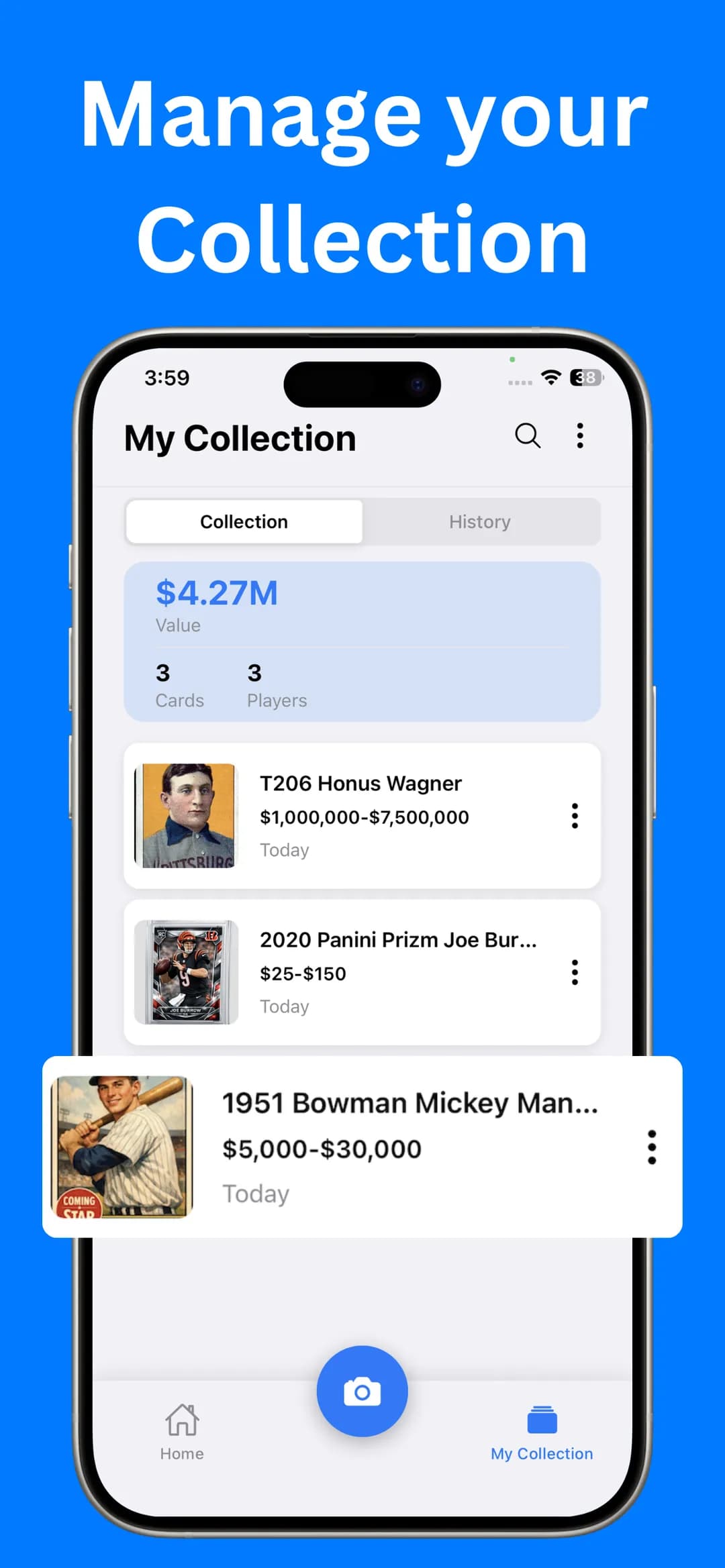
Yes. Sports Card Value Scanner works as a catalog you build while you sort. Scan each card, check the year, set and card number on the result, and tap Save to Collection. My Collection then shows your total value, card count and number of players, with a History tab and search for finding a card later. You can also export the list of all your scanned cards to a file, which helps if you keep a spreadsheet too. On Android, the latest update adds collection stats and a multi-select mode.
Once everything is sorted, our guide on how to value a sports card collection shows how to work out what it all adds up to.
Frequently asked questions
What's the best way to organize sports cards?
Sort by sport, then year and set, then card number, and store the cards in labelled boxes that follow the same order. Keep valuable cards in their own box, and catalog the collection so you can find cards without digging.
Should I organize cards by team or by set?
Set order is easier to maintain and matches price guides and checklists. Team order suits fans who collect one team. Pick the one that matches how you look for cards, and stay consistent.
How do I keep track of my card collection?
Use a spreadsheet or a card scanner app. A scanner app fills in the card details from a photo, which is much faster when you have hundreds of cards.
Sources

Find out what your cards are worth
Scan your first card in seconds. Get the card details, a reference price range and a rarity score, then build a collection you can track.


4.5★ App Store (75) · 4.4★ Google Play (79) · Free to download