
Article · 5 min read
How Much Is My Baseball Card Worth?
· By the Sports Card Value Scanner team
Quick answer
Most common baseball cards are worth very little, often less than a dollar. But rookies of star players, vintage cards in good condition, low-numbered parallels and autographs can be worth hundreds or more. To find out what yours is worth, identify the exact card (year, brand, player, card number), judge its condition and check recent sold prices for the same card. A baseball card value app like Sports Card Value Scanner handles the first steps from one photo. It identifies the card and shows a reference price range and a rarity score.
A baseball card's value comes down to a handful of factors: who the player is, when the card was made, whether it's a rookie card, how scarce that exact version is, and what condition it's in. Most cards printed from the late 1980s through the mid-1990s were made in such huge numbers that commons from those years sell for pennies. Vintage cards of stars, true rookie cards, low serial-numbered parallels, autographs and certain error cards are where real money usually sits. The only reliable price is what the same card in the same condition has recently sold for, so identify the card exactly, judge the condition honestly, and check sold listings. A scanner app gives you a fast first estimate and a rarity score, which helps you decide which cards deserve that deeper check.
| Biggest factors | Player, era, rookie status, rarity, condition and grade |
|---|---|
| Mostly low value | Base cards from 1987 to 1994 |
| Price from | Recent sold listings for the same card in the same condition |
| Grading | Pays mainly for valuable cards in excellent shape |
| Never | Clean, flatten or trim a card |
What makes a baseball card valuable?
The player, the era, rookie status, rarity, condition and grading decide most of a baseball card's value.
| Factor | Raises value | Lowers value |
|---|---|---|
| Player | Hall of Famers, current stars, popular rookies | Common players |
| Year and era | Pre-1980 vintage and key modern rookie years | Mass-produced 1987–1994 “junk wax” cards |
| Rookie status | The player's first licensed cards (“RC”) | Later-year base cards |
| Rarity | Short prints, serial-numbered parallels, autographs | Base cards with huge print runs |
| Condition | Sharp corners, good centering, clean surface | Creases, soft corners, stains, off-centre |
| Grading | High grades from PSA, BGS or SGC | Low grades or altered cards |
How do you check a baseball card's value?
Identify the card, look for rookie and parallel clues, judge the condition honestly and compare recent sold prices for the same card.
- 1
Identify the card
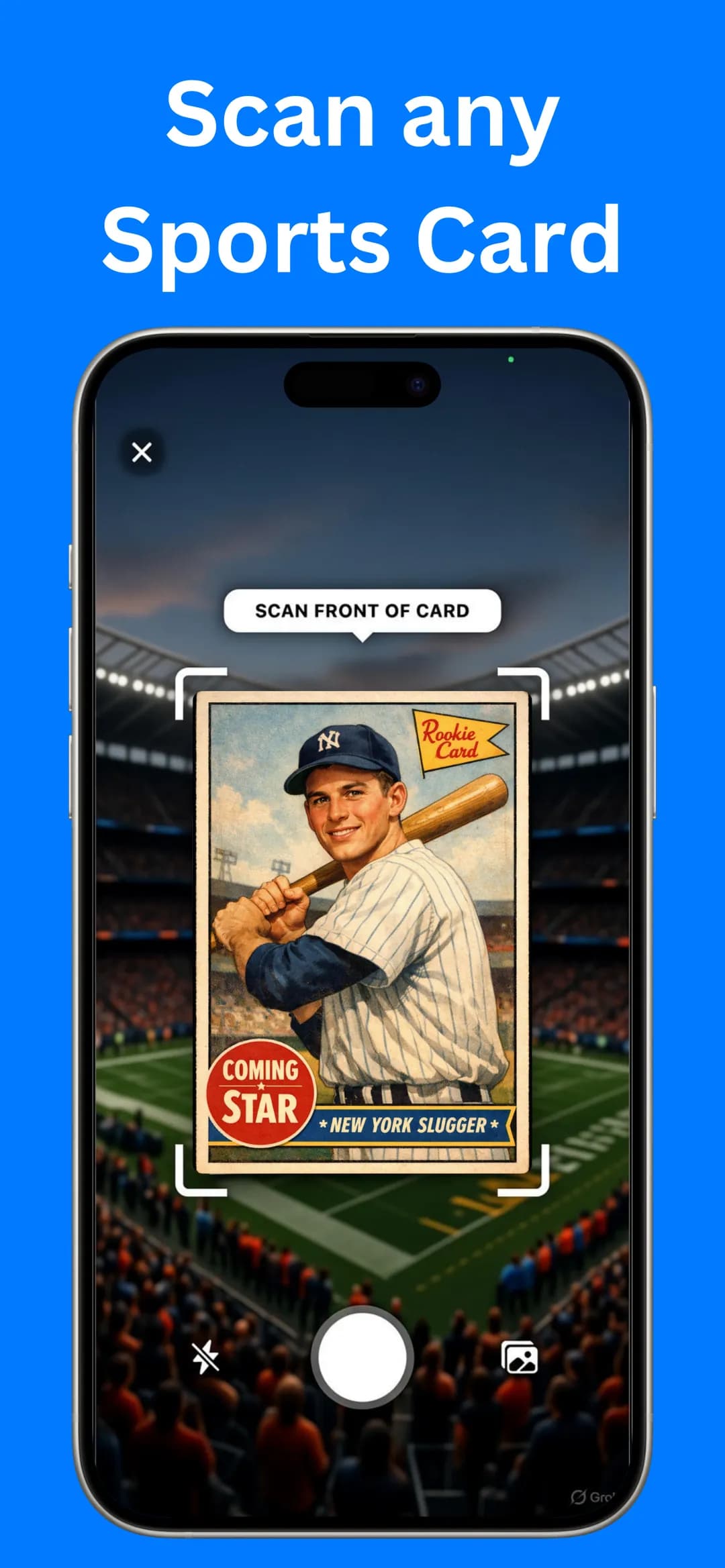
Read the back for the copyright year, brand and card number, or scan the front with a baseball card scanner app. Details matter: a 1989 Upper Deck Ken Griffey Jr. #1 and a 1989 Donruss Griffey are different cards with different values.
- 2
Look for rookie and parallel clues
Check for an RC logo, a serial number (like 12/50), a refractor finish or coloured border, or an autograph. Any of these can raise the value well above the base card.
- 3
Judge the condition honestly
Look at the corners, edges, surface and centering under good light. Creases and soft corners pull an ungraded card's value down sharply.
- 4
Check recent sold prices
Search the exact card on eBay, filter to sold listings and work from the most recent sales in similar condition. Our guide on how to price sports cards on eBay explains each step.
Is there a baseball card value app?
Yes. If you have more than a few cards, a baseball card value app turns a long lookup into a quick photo. Sports Card Value Scanner works as a baseball card value app for Android and iPhone. It identifies baseball cards from all eras and shows:
- The card's name, year and set, for example “1951 Bowman Mickey Mantle Rookie Card”.
- A Reference Price range and estimated eBay values.
- A Rarity Score out of 10, on a scale from Common to Ultra Rare.
- Card Information with the sport, year issued, series and card number.
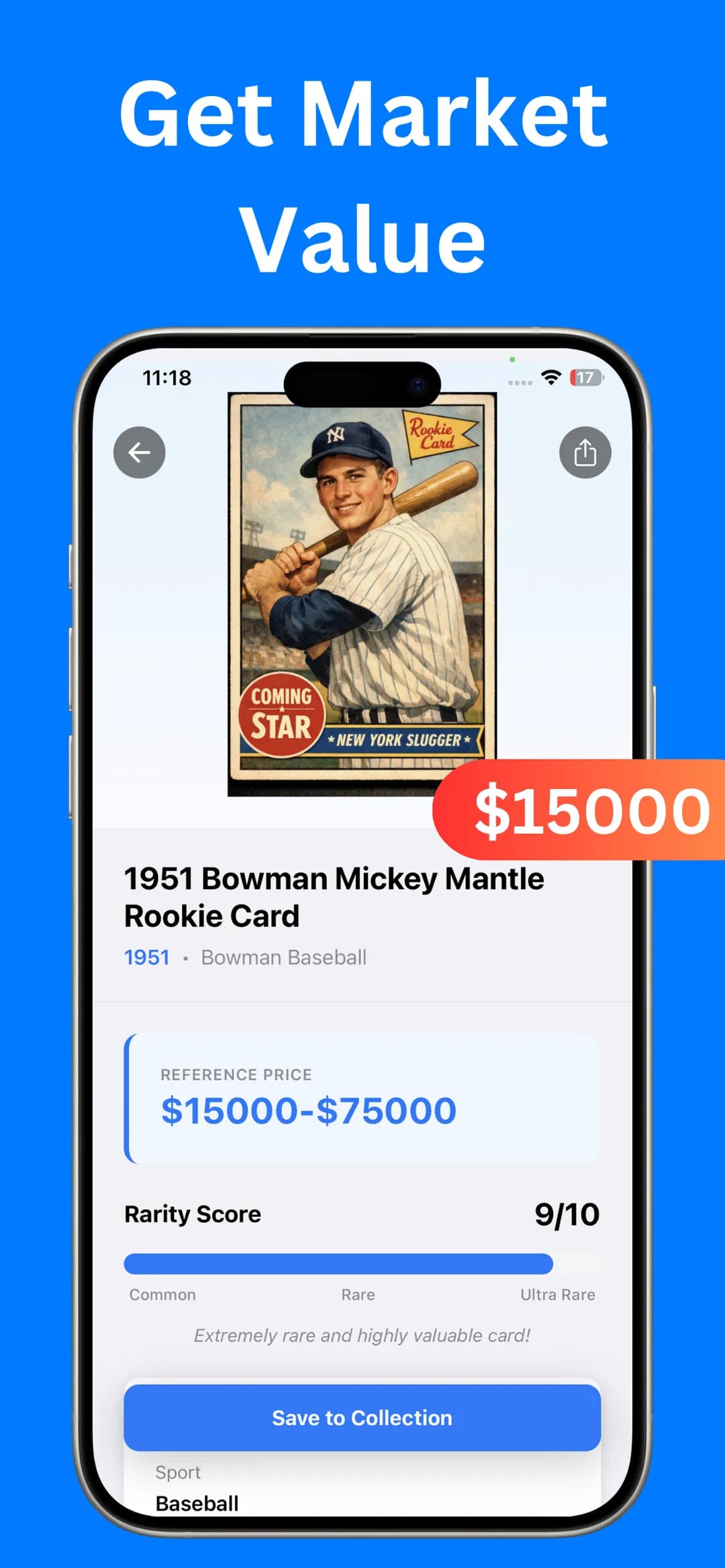
Save the cards you want to keep to My Collection to see their combined value, the number of cards and the number of players.
Which baseball cards are usually worth checking?
Pre-war and 1950s to 1960s cards, rookie cards of Hall of Famers and current stars, low-numbered parallels, autographs, corrected errors and high-grade key cards are worth checking.
- Pre-war and 1950s–1960s cards, especially Topps and Bowman stars, even in rough condition.
- Rookie cards of Hall of Famers and current stars, including modern “1st Bowman” prospect cards.
- Low serial-numbered parallels and autographs from modern sets.
- Error and variation cards that were corrected or pulled during production.
- High-grade copies of key cards that have been professionally graded.
Base cards from roughly 1987 to 1994 are the opposite case. They were printed in enormous numbers, so unless a card is a key rookie in top condition, it's usually worth little. Read are my old sports cards worth anything? for an era-by-era breakdown.
Should you get your baseball card graded?
Grading companies such as PSA, BGS and SGC authenticate a card and give it a condition grade from 1 to 10. For a valuable card in excellent shape, a high grade can raise the price substantially. For common cards, the grading fee usually costs more than the card is worth. Scan first, check the rarity score and value range, and only consider grading the cards that stand out.
Does the same approach work for football and basketball cards?
Yes. The same approach works across sports. See how much is my football card worth and how much is my basketball card worth. If you're holding a first-year card, how much is my rookie card worth covers what makes rookies special.
Frequently asked questions
Is there an app that tells you what baseball cards are worth?
Yes. Sports Card Value Scanner is a baseball card scanner app for iPhone, iPad and Android. Take a photo of the card and it shows the card details, a reference price range, estimated eBay values and a rarity score in seconds.
Are baseball cards from the 1990s worth anything?
Most base cards from the late 1980s and early 1990s are worth little because they were mass-produced. Exceptions include key rookies in top condition, inserts and certain error cards. Scan them to find the ones worth a closer look.
Sources

Find out what your cards are worth
Scan your first card in seconds. Get the card details, a reference price range and a rarity score, then build a collection you can track.


4.5★ App Store (75) · 4.4★ Google Play (79) · Free to download