
Article · 5 min read
How Much Is My Rookie Card Worth?
· By the Sports Card Value Scanner team
Quick answer
A rookie card's worth depends on who the player is, which set and version it is, and its condition. Rookie cards of stars and Hall of Famers can be worth hundreds or far more, while rookies of players who never broke out are often worth little. To check rookie card value, confirm it's a true rookie card, identify the exact set and parallel, and compare recent sold prices. Or scan it with Sports Card Value Scanner for a value range and rarity score in seconds.
A rookie card is a player's first officially licensed card from a major manufacturer, and it's usually the most collected card of that player's career. Its value depends on four things. The player matters most: rookies of stars and Hall of Famers hold value, while rookies of players who didn't break out often sell for little. The set and version come next, since flagship and premium sets are the most collected and parallels or serial-numbered versions are scarcer than the base rookie. Autographs add a premium, and condition, especially a high professional grade, can multiply the price. Rookie prices also move with performance, playoff runs and awards. To check yours, confirm it's a true rookie card, identify the exact set and parallel, and compare recent sold prices for the same card in the same condition.
| Definition | A player's first officially licensed card from a major manufacturer |
|---|---|
| How to spot one | An RC logo, a 1st Bowman label, few or no stats, or a rookie subset |
| Biggest value factor | The player's career |
| Scarcer versions | Coloured, refractor and serial-numbered parallels |
| Price from | Sold listings for the exact version in the same condition |
What is a rookie card?
A rookie card (RC) is generally a player's first officially licensed trading card from a major manufacturer, issued around the player's first season. Collectors value rookie cards because they mark the start of a career and are the earliest widely available cards of that player.
Definitions vary at the edges. Some collectors count earlier prospect, minor league or college cards, while others only count the first licensed card in a major-league set. Here's how to spot one:
- RC logo. Many modern licensed cards print an “RC” logo on rookie cards.
- 1st Bowman. In baseball, a player's first Bowman card is marked “1st Bowman”. Technically it's a prospect card, but it's collected much like a rookie card.
- Little or no stats. Rookie cards usually show few or no major-league stats on the back.
- Rookie subsets. Some sets group rookies into a special subset with its own design.
What drives rookie card value?
The player's career matters most, followed by the set and brand, the parallel and print run, any autograph, condition and timing.
| Factor | Why it matters |
|---|---|
| Player's career | Rookie card values rise and fall with performance; Hall of Famers hold value best |
| Set and brand | Flagship and premium sets (such as Topps, Bowman Chrome and Panini Prizm) are the most collected |
| Parallel and print run | Coloured, refractor and serial-numbered versions are scarcer than the base rookie |
| Autograph | Rookie autographs, especially on-card ones, are among the most sought-after modern cards |
| Condition and grade | High grades from PSA, BGS or SGC can multiply value |
| Timing | Prices often spike with hot streaks, playoffs and awards, then cool off |
How do you check your rookie card's value?
Confirm it's a true rookie card, identify the exact version, compare sold prices in the same condition and track it once you know.
- 1
Confirm it's a rookie
Look for the RC logo or a 1st Bowman designation, and check the back for previous stats. If you're unsure which card you have, read how to identify sports cards.
- 2
Identify the exact version
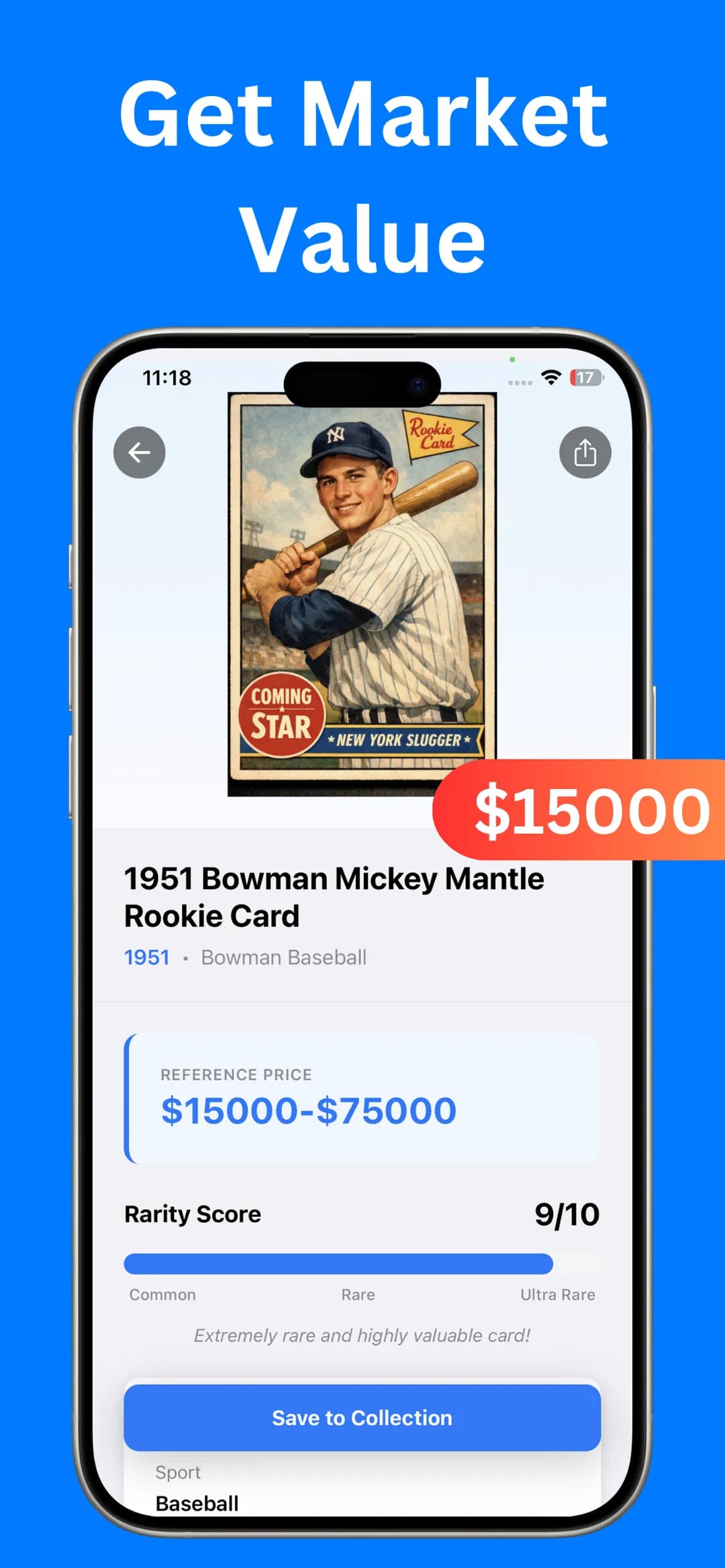
The year, set, card number and parallel all matter. Scan the card with Sports Card Value Scanner to see the year, series and card number, plus a reference price range and rarity score.
- 3
Compare sold prices
Search the exact card on eBay, filter to sold listings and compare copies in the same condition or grade. Our guide on how to price sports cards on eBay explains how.
- 4
Track it
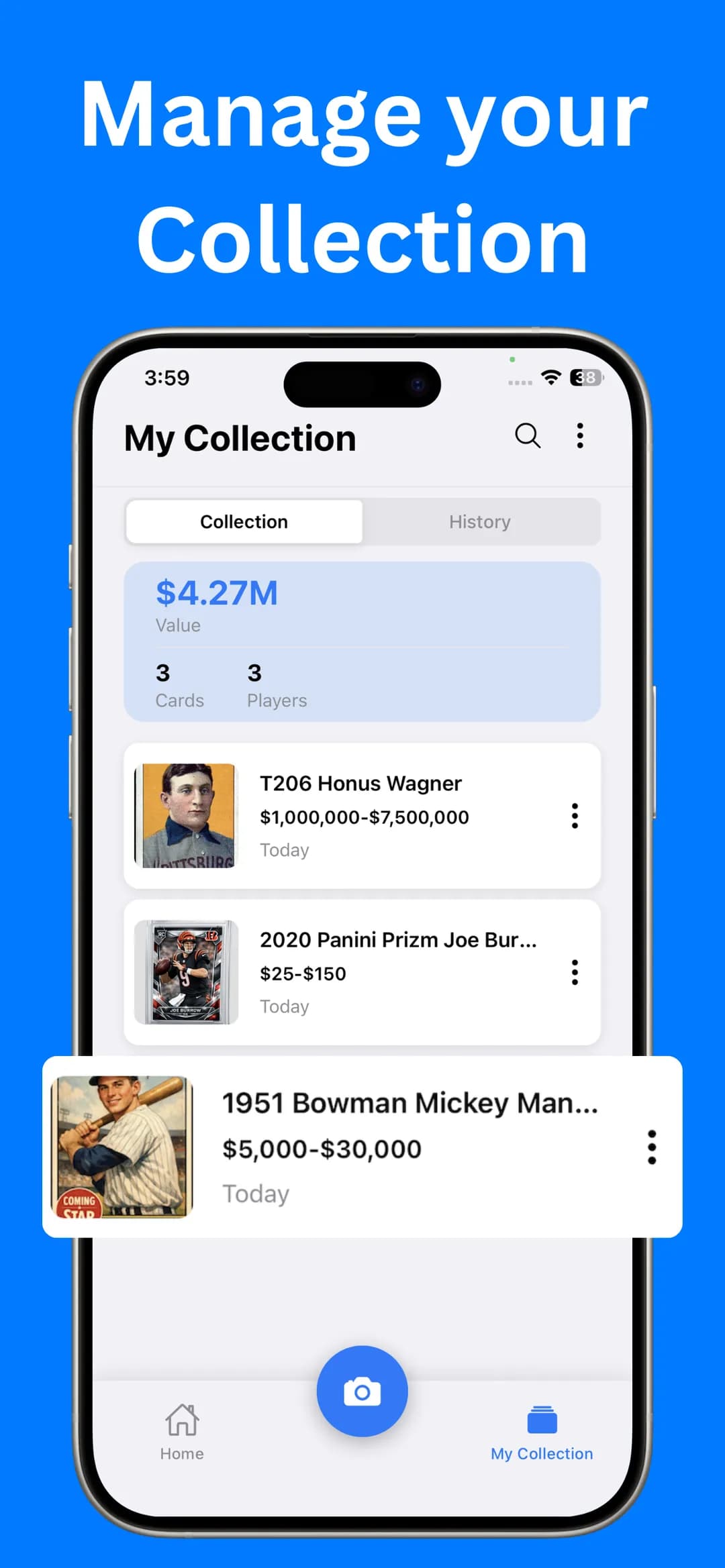
Save it to My Collection so you can come back to it and see its value range alongside your other cards.
How does rookie card value differ by sport?
Baseball rewards vintage legends and 1st Bowman prospects, football demand centres on quarterbacks, and basketball is driven by stars and chrome parallels.
- Baseball: vintage rookies of legends are blue-chip cards, and modern collectors also chase 1st Bowman prospects. See how much is my baseball card worth.
- Football: quarterback rookies dominate demand, and rookie patch autographs top modern sets. See how much is my football card worth.
- Basketball: a star-driven market where chrome rookies and their parallels trade heavily. See how much is my basketball card worth.
Two of the most searched rookies show how much the version and grade matter: see Michael Jordan rookie card value and Ken Griffey Jr. rookie card value.
Should you sell a rookie card now or hold it?
Nobody can predict a player's career, so think in terms of risk. Prices for young players often peak during early hype. Selling some cards during a hot streak locks in gains, while holding tends to make more sense for established stars whose cards have a long track record. Either way, check recent sold prices before you decide, and keep valuable rookies protected in sleeves and top-loaders.
Want a broader checklist? Read how to tell if a sports card is valuable.
Frequently asked questions
What does RC mean on a sports card?
RC stands for rookie card. Many modern licensed cards print an RC logo to mark a player's official rookie cards.
Are all rookie cards valuable?
No. Rookie cards of players who don't become stars are often worth little, and base rookies from mass-produced sets may be inexpensive. Star players, scarce parallels, autographs and high grades are what drive value.
Sources

Find out what your cards are worth
Scan your first card in seconds. Get the card details, a reference price range and a rarity score, then build a collection you can track.


4.5★ App Store (75) · 4.4★ Google Play (79) · Free to download