
Step-by-step guide · 5 min read
How to Identify Sports Cards: Player, Year, Set and Card Number
· By the Sports Card Value Scanner team
Quick answer
To identify a sports card you need five details: the player, the year, the brand or set, the card number and any parallel or special feature. Most of these are printed on the back. The card number usually sits in a corner, and the manufacturer and copyright year are in the fine print. A sports card identifier app like Sports Card Value Scanner reads the front of the card from one photo and shows the player, year, series and card number in seconds.
Five details pin down any sports card: the player, the year, the brand or set, the card number, and whether it's a parallel or special version. The back of the card holds most of them. Modern cards print the year in a copyright line and put the card number in a corner. Older cards may skip the year, so collectors read the last season in the stats table and add one. Parallels are the trickiest part, because they share the base card's design and differ only in colour, finish or a stamped serial number. Once you know those five details, you can search sold listings for the exact card instead of a dozen lookalikes. A sports card identifier app speeds this up by reading the front of the card and returning the year, series and card number from one photo, which you can then confirm against the back.
| Details to record | Player, year, brand and set, card number, and any parallel or feature |
|---|---|
| Where the year is | The copyright line on the back, or the year after the last season in the stats |
| Where the card number is | Usually the most prominent number on the back, often in a corner |
| Parallel clues | A different border colour, a refractor or foil finish, or a serial number like 23/99 |
| Fastest method | Scan the front with a sports card identifier app, then confirm against the back |
What details identify a sports card?
Five details identify any sports card: the player, the year, the brand and set, the card number, and any parallel or special feature such as a serial number or autograph.
| Detail | Where to find it | Why it matters |
|---|---|---|
| Player | Front of the card and the name line on the back | Value follows the player first |
| Year | Copyright line on the back, or the season after the last stats line | The same player in a different year is a different card |
| Brand and set | Manufacturer logo on the front or back (Topps, Bowman, Panini, Upper Deck, Fleer, Donruss) | Sets have very different print runs and demand |
| Card number | Usually the most prominent number on the back, often in a corner | Separates base cards from inserts and variations |
| Parallel or feature | Border colour, refractor or foil finish, a serial number like 23/99, an autograph or a patch | Parallels and numbered cards are scarcer |
Where do you find a baseball card's year and card number?
If you're working out how to identify a baseball card year and card number, both are printed on the back. On most cards from the 1980s onward, the year appears in the copyright line, in small print near the bottom edge (for example, “© 1989 The Topps Company”). The card number is usually the most prominent number on the back, printed in a corner or in a small box near the player's name.
Older cards can be trickier. If there's no copyright date, look at the statistics table. Cards were usually issued the year after the last season shown, so stats that end in 1972 point to a 1973 card. Some vintage cards don't print a year at all, and a few early sets have no card numbers. That's where a checklist, a price guide or an app helps.
Football and basketball cards follow the same pattern: the copyright year and card number are on the back, and the brand logo is usually on the front.
How do you spot parallels, inserts and rookie cards?
Compare the card with the base version. A different border, finish or stamped serial number means a parallel, a separate design means an insert, and an RC logo usually marks a modern rookie card.
- Parallels share the base card's design but change the colour, border or finish (refractor, prizm, holo). If the border or shine differs from the common version, you probably have a parallel.
- Serial-numbered cards carry a stamped number such as 045/199. The lower the print run, the scarcer the card.
- Inserts are special subsets with their own design and numbering, often with letters before the card number.
- Rookie cards on modern sets often carry an “RC” logo. For older cards, check whether it's the player's first card in a major set. See how much is my rookie card worth.
- Autograph and memorabilia cards include a signature (on the card or on a sticker) or a swatch of jersey.
Can a sports card identifier app identify a card from a photo?
Yes. A sports card identifier app turns each card into a single photo, which is much faster than reading every card back when you have a binder or a shoebox to get through.
- 1
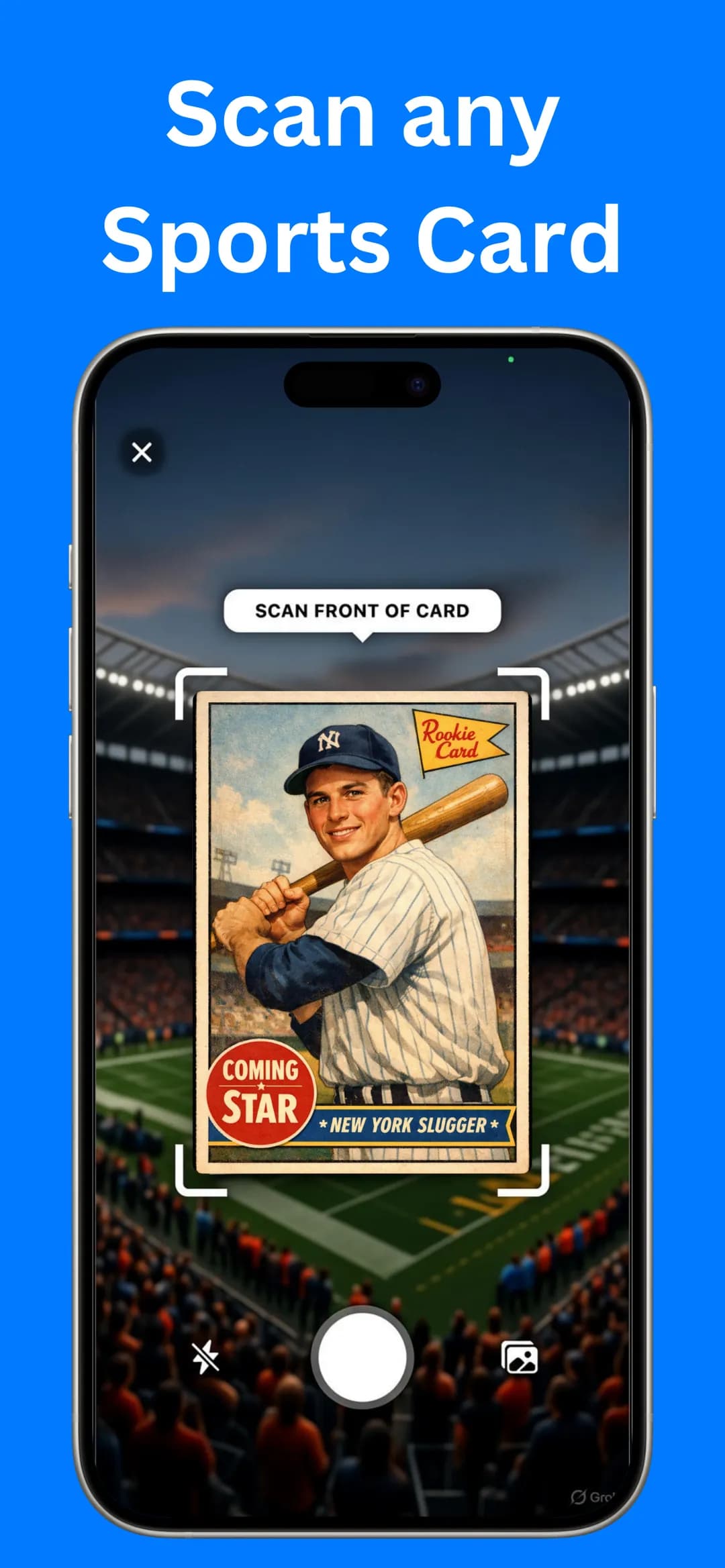
Scan the front
Open Sports Card Value Scanner and frame the front of the card inside the guides, or choose a photo from your gallery.
- 2
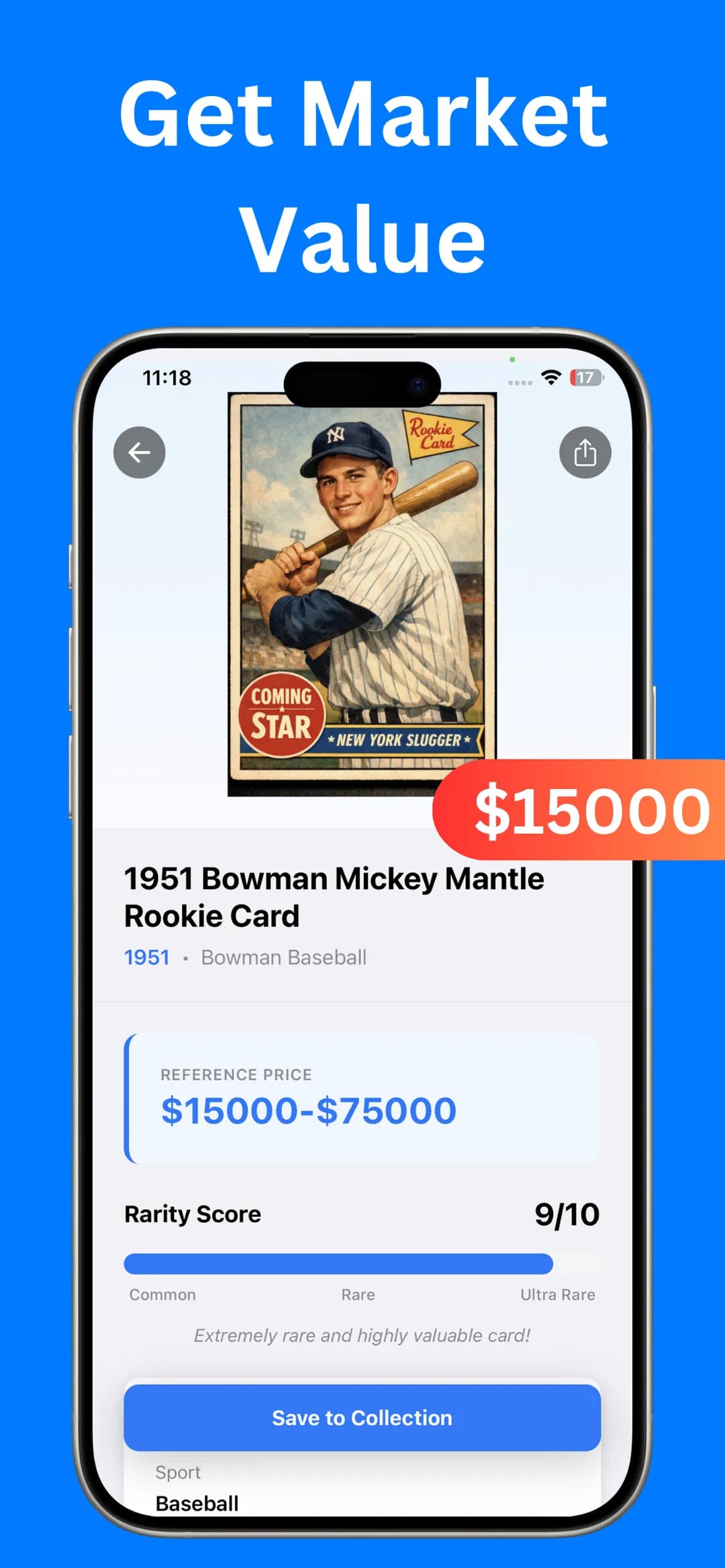
Read the match
The result screen shows the card title, year and set, for example “1951 Bowman Mickey Mantle Rookie Card · 1951 · Bowman Baseball”, along with a reference price range and rarity score.
- 3
Confirm the details
Scroll to Card Information and compare the sport, year issued, series and card number with the back of your card. If they match, you've identified the exact card.
- 4
Save it
Tap Save to Collection so the card and its value range stay in My Collection and you never have to look it up again.
What should you do if the identification doesn't match your card?
If the year or card number in the result doesn't match the back of your card, check the copyright line and card number yourself. Then retake the photo in better light, and make sure you're scanning the front. Parallels can look almost identical to base cards, so confirm the finish and any serial number by eye before you price the card.
What should you do after you identify a card?
Once you know exactly which card you have, you can price it. Start with how to scan sports cards for value, then read the value guide for your sport: baseball, football or basketball.
Frequently asked questions
Can an app identify my sports card from a photo?
Yes. Sports Card Value Scanner identifies a card from a camera shot or a photo in your gallery. It shows the player, year, series and card number, along with a reference price range and a rarity score.
Where is the card number on a baseball card?
On the back. It's usually the most prominent number, printed in a corner or in a small box near the player's name. Combine it with the year and brand to pin down the exact card.
How do I find the year on an old card without a copyright date?
Look at the stats on the back. Cards were typically issued the year after the last season listed, so stats ending in 1975 usually mean a 1976 card.
Sources

Find out what your cards are worth
Scan your first card in seconds. Get the card details, a reference price range and a rarity score, then build a collection you can track.


4.5★ App Store (75) · 4.4★ Google Play (79) · Free to download