
Article · 4 min read
The PSA Grading Scale, Explained Grade by Grade
· By the Sports Card Value Scanner team
Quick answer
The PSA grading scale runs from 1 (Poor) to 10 (Gem Mint). PSA 10 is a virtually perfect card, PSA 9 (Mint) allows one minor flaw, and PSA 8 (Near Mint-Mint) allows a few small ones. Lower grades reflect more visible wear on the corners, edges, surface and centering. PSA also gives half grades to cards at the top of a grade, and adds qualifiers like OC (off-center) for one specific flaw.
PSA, the largest sports card grading company, rates cards on a 10-point scale based on four things: centering, corners, edges and surface. Each grade has a name: 10 Gem Mint, 9 Mint, 8 Near Mint-Mint, 7 Near Mint, 6 Excellent-Mint, 5 Excellent, 4 Very Good-Excellent, 3 Very Good, 2 Good, 1.5 Fair and 1 Poor. Genuine cards that can't receive a number, often because they've been altered, can come back marked Authentic. Half grades such as 8.5 reward cards at the high end of a grade, and qualifiers flag one specific problem, for example OC for off-center or ST for staining. The scale matters because prices don't rise in a straight line. For many modern cards, a PSA 10 sells for several times the price of a PSA 9, simply because 10s are much rarer.
| Scale | 1 (Poor) to 10 (Gem Mint) |
|---|---|
| Half grades | Given to cards at the high end of a grade, up to 8.5; there's no PSA 9.5 |
| PSA 10 centering | About 55/45 or better on the front and 75/25 or better on the back |
| Qualifiers | OC, ST, PD, OF, MK and MC mark one specific flaw |
| Price effect | Each step up is rarer, so prices climb faster than the numbers |
What does each grade on the PSA grading scale 1-10 mean?
PSA grades run from 1 (Poor) to 10 (Gem Mint), and each step up means fewer flaws in the corners, edges, surface and centering.
| Grade | Name | What it looks like |
|---|---|---|
| 10 | Gem Mint | Virtually perfect: sharp corners, clean surface, near-perfect centering |
| 9 | Mint | One minor flaw, such as slight off-centering or a tiny print mark |
| 8 | Near Mint-Mint | A few small flaws, like slight wear on a corner or a minor print spot |
| 7 | Near Mint | Slight surface wear or corner fraying on close inspection |
| 6 | Excellent-Mint | Visible surface wear and slightly rough corners or edges |
| 5 | Excellent | Minor rounding of corners and some surface wear |
| 4 | Very Good-Excellent | Slightly rounded corners, noticeable wear, possibly a light crease |
| 3 | Very Good | Rounded corners, surface wear, possible crease |
| 2 | Good | Obvious wear, rounded corners and creases |
| 1.5 | Fair | Heavy wear and creasing, but the card is intact |
| 1 | Poor | Major damage, possibly missing pieces |
How does PSA judge centering?
Centering compares the widths of opposite borders. A card with equal borders is 50/50, and one with a wider left border might be 60/40. For a PSA 10, PSA's standards call for roughly 55/45 or better on the front and 75/25 or better on the back, and a PSA 9 allows about 60/40 on the front. A card that's sharp everywhere but poorly centered usually lands a grade or two lower than you'd expect.
What are PSA half grades and qualifiers?
PSA gives half grades, such as 7.5 or 8.5, to cards at the high end of a grade. There's no PSA 9.5. Qualifiers work differently. They mark a card that meets a grade's standards except for one specific problem:
- OC: off-center
- ST: staining
- PD: print defect
- OF: out of focus
- MK: marks, such as writing
- MC: miscut
A qualified grade, such as PSA 8 (OC), usually sells for noticeably less than the same grade without a qualifier.
How does the PSA grade affect price?
Here's the PSA grading scale explained in one line: each step up is rarer, so prices climb much faster than the numbers. For many modern cards, 10s are a small share of graded copies, so a 10 can sell for several times a 9. With vintage cards, high grades are rarer still, and even a PSA 5 or 6 of a key card can be valuable. Always compare prices for the exact grade you have.
How does PSA compare with other graders?
BGS and SGC also use 10-point scales, but they label grades differently, and BGS adds subgrades for centering, corners, edges and surface. Our PSA vs BGS vs SGC comparison lays the three side by side, and the sports card terms glossary covers labels like Pristine and Black Label.
Which cards should you send to PSA?
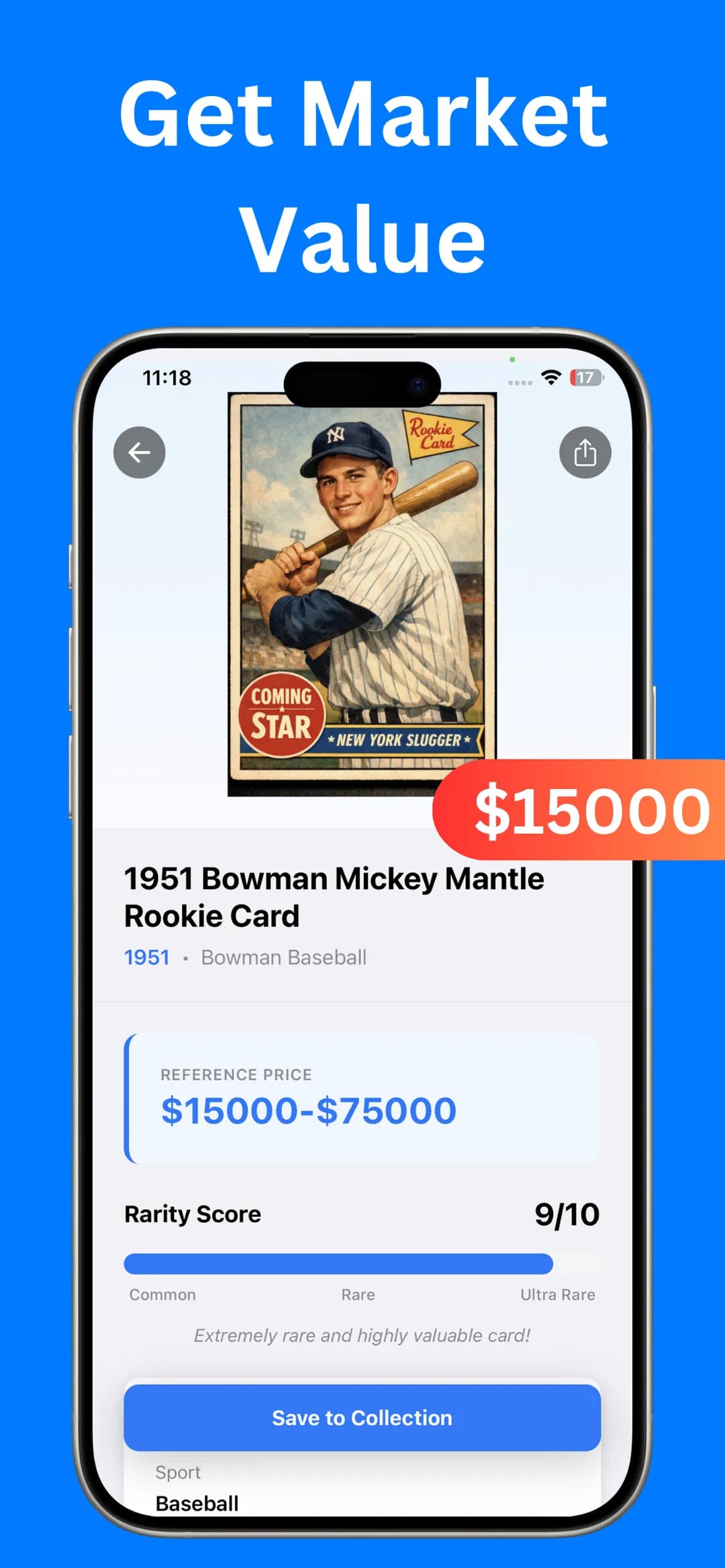
Grading costs money, so pick cards where a high grade would clearly pay. Sports Card Value Scanner doesn't grade cards, but it gives you each card's reference price range and rarity score. That's a quick way to find the cards worth checking for centering, corners, edges and surface before you submit. Then follow our guide on how to get cards graded.
Frequently asked questions
What does PSA 10 mean?
PSA 10, or Gem Mint, is PSA's top grade, given to a virtually perfect card: sharp corners, clean edges and surface, and near-perfect centering.
Is there a PSA 9.5?
No. PSA uses half grades up to 8.5, then whole grades 9 and 10. BGS and SGC do use a 9.5.
What does OC mean on a PSA card?
OC stands for off-center. It means the card meets the standards of the grade shown except for its centering, and it usually sells for less than the same grade without the qualifier.
Sources

Find out what your cards are worth
Scan your first card in seconds. Get the card details, a reference price range and a rarity score, then build a collection you can track.


4.5★ App Store (75) · 4.4★ Google Play (79) · Free to download